Rembrandt is so uniquely and scientifically designed that it pierces
through surface impressions and gets to the person's "TRUE SELF."
Rembrandt Portrait tells you what you need to know - Who the person
is, how they will perform, and whether you should hire the
person and/or continue to invest in them. Rembrandt Portrait is a
highly valid personality assessment profile that has no adverse impact
on protected groups. It can predict success on the job with 85.5%
accuracy and can identify top talent with 97% accuracy.
If your job is to hire, retain and develop a superior work force you
should be using the Rembrandt Portrait.
Rembrandt Portrait accurately measures the 14 inherent qualities that
make up the human personality and predict job success. After
a person completes the Rembrandt Portrait, our trained Talent Advisors
and customized reports will provide a comprehensive assessment of the
employee or job candidate's inherent qualities and will tell you how
well they match the critical competencies required for your position.
From administrative, front office and client service representative to
sales, leadership, technical and creative positions. The Rembrandt
Portrait will allow you to hire and develop only the very best
employees.
Examples of what you will learn with The Rembrandt Portrait:
How the person thinks and solves problems
The
strength of their relationship building, interpersonal savvy and
service motivation
The way they communicate, lead, negotiate and close sales
Their initiative - how well do they plan and execute,
drive performance and stay on top of their work and
objectives
Rembrandt gets to a person's true self allowing you to see
who they really are and how they will perform. Just imagine how much
more successful your company could be and the employee productivity
you would unleash if you knew every employee's true
capability?.....You could:
Always hire top talent and target essential learning
Identify and develop effective/future leaders
Create a culture of achievement
Retain top people
Become employer of choice!
We welcome a conversation with you to see how we can help change your
world!
To understand the transformative power of The Rembrandt Portrait and
the way it can support organizational achievement and your ability to
hire,
retain and develop a world class workforce
we first must look at workforce competencies and their construct.
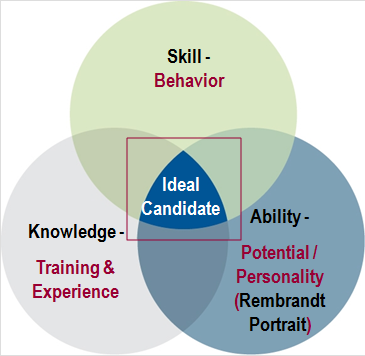
By definition, a competency is a person's skill, knowledge and ability
for a purpose. Purpose is defined by the job's objectives, knowledge
is what the person has learned and knows and, skill is the
demonstrated behavior you see and observe. Ability is the innate
strengths of the person - what they bring to the equation - their
drives, motivations, predilections, core capabilities and limitations.
It is who the person is and how they work and perform.
As you see in the above graphic, "Ability" is a critical component of
every competency, so no complete competency exists if the person lacks
the "Ability" or potential to perform. Sometimes an employee can
perform satisfactorily because of their technical capability or
interpersonal skills alone, but if they lack the "Ability" to perform,
the innate potential, the statistical probability is they will not
achieve top performance. It’s like a high school student who wants to
play pro basketball but is only 5' 6" tall. What are the chances that
he or she will possess the extraordinary talent required for them to
overcome their lack of height or "Ability?" It's certainly possible,
just not probable. And when hiring and developing Top Talent, you must
be able to predict an individual's performance and potential with high
certainty.
It therefore becomes critical for every person's "Ability" to be
measured and quantified (psychometric analytics), whether a job
candidate or current employee, if we are expected to make effective
decisions regarding the way Top Talent is secured, retained and
developed. By measuring "Ability" we will know how the person fits the
job, what can be done to support and lead them and where their
potential will allow them to grow within the organization. This is
where The Rembrandt Portrait plays a strategic role; Helping you hire
the very best then developing your people and organization to their
greatness.
The Rembrandt Portrait is so powerful it unveils the critical and
differentiating abilities of potential job candidates to help you make
effective personnel decisions. We help you select the right person for
the right position to create a world-class workforce.
Rembrandt Portrait Personality Assessment
Rembrandt Portrait provides such an accurate portrait of the candidate
and their capabilities that you no longer need to guess if someone has
the competency to performance with excellence. You will pierce through
surface impressions of each candidate and with the precision and
certainty of our assessment technology, identify the very best person
for the job. No more surprises! No more hiring blind.
Targeting Your Interview
While standard interview protocols provide some value by providing
consistency in the selection process, the only way to uncover a
candidate's true capabilities is to customize your approach and target
potentially limiting factors. Rembrandt Portrait guides you through
the interview process and provides targeted, valid, probing questions
to pin down the person’s strengths and limitations.
RembrandtAdvantage will prove invaluable to you, with our ability to
provide you with the insightful information needed to develop your
employees, increase their productivity and ultimately increase the
performance of your organization.
Rembrandt Portrait
Rembrandt Portrait should be used as an integral part of your employee
development process, providing the important information you need to
make effective personnel decisions.
CareerNavigator
The Rembrandt CareerNavigator is a multi-rater performance evaluation
tool that identifies employee competency, performance trends and
learning and development opportunities. It can simplify, shorten, and
improve your employee appraisal and career planning process. It also
offers key solutions to busy line management by being self-empowering,
easily administered, cost-effective, and time efficient.
We will uncover your company’s morale issues (positive and negative)
and your client’s overall satisfaction thereby increasing the
company’s productivity and contributing to the attainment of the
company’s goals and objectives.
Morale Survey
Let your employees know their opinions matter and gain insight into
the strengths and weaknesses of your work culture, compensation
practices and management effectiveness.
Client Survey
The Client Survey is a tool designed to help you understand how your
customers feel about your company, what they value and what they would
like to know more about.
As a RembrandtAdvantage partner, you will be able to become a true
Human Resources solutions firm to your customers. We offer our
partners the opportunity to secure the right to represent, sell and
distribute our selection system into their customer base. Here is what
is included in RembrandtAdvantage partnership:
Unlimited use of and distribution rights to Rembrandt Portrait
personality profile. While other firms say they have proprietary
personality testing, as a RembrandtAdvantage partner you can compete
with a profile validated over 30 years.
Structured Interview Processes for four core positions built on valid
and reliable questions proven to uncover the skill or attribute to be
identified.
Psychometric hiring models - models proven to identify top performers
- for almost any position and the ability to access RembrandtAdvantage
to custom create hiring models for your customer’s specific positions.
Protected territory - no other firm will have the right to sell
RembrandtAdvantage services into the territory licensed to you.
But they looked so good in the interview . . .
Michael Santo, Ph.D.
Are you aware of the many interview misconceptions that can sabotage
even the most experienced manager or HR professional? A mistake during
the employee selection process can turn into a financial nightmare.
Empowerment Concept’s extensive experience in human resources
consulting has proven that the most common error made by managers and
HR professionals is hiring based on a candidate’s past industry
experience. Our research, despite the common misconception, shows that
experience is not the best indicator of future success. Sales
professionals with years of industry experience often don't live up to
expectations. Of all the myths of the selection process, this hiring
practice is the most difficult for us to change in our customers.
Regardless of a firm’s size or industry, managers continually rely
upon the candidate’s experience to make hiring decisions. It is
obviously easier to hire someone with past industry experience and
relevant knowledge of products, services, and competition. The premise
being that someone with substantial work experience will require less
training and direction than a person lacking previous experience.
If this criteria is truly a predictor of future success, why do we
consistently hear, "But they looked so good in the interview! What
happened?" The price of basing hiring decisions on experience can be
enormous, both in terms of lost opportunities and money wasted on
recruiting and training a new employee. When consulting our clients,
we encourage them to critically evaluate an "experienced" candidate
who is currently working for a competitor. What is it your firm offers
that is not offered by his current employer? Why is this candidate
willing to sacrifice the perks that come with seniority and experience
in exchange for beginning his career all over again?
A decade of research has shown Empowerment Concepts that more often
than not, the experienced candidate is a marginal performer in his
current position. He is often seeking a new home where his mediocrity
won’t be noticed for years. This candidate may have seven years
experience working for one of your competitors, but could these seven
years of experience really be one bad year repeated seven times?
Unfortunately for corporate America, this tends to be the rule rather
than the exception. A large majority of hires based on experience
result in nothing more than re-circulating mediocrity.
Put yourself in the shoes of a college football coach and pretend you
are recruiting a new Linebacker. There are two candidates seeking the
position. One has extensive high school playing experience. The other
has none. The experienced candidate weighs 150 pounds and stands 5’9’’
yet possesses impeccable credentials for the sport. He knows the sport
well and understands how particular strategies are used to help win
the game. The second, nonexperienced candidate weighs 275 pounds of
pure muscle and stands 6’4’’. He has the strength of an Olympic weight
lifter and can run the 40yard dash in just four seconds. He knows
football, but he hasn’t played the game since he was in grade school.
Being the coach, which player would you recruit? The lightweight with
years of experience or the mass of muscle with lighting fast reflexes?
Do you really believe that the lightweight’s experience can give him
the edge over the physically superior candidate? No coach with sound
mind would be confused about which candidate to recruit.
The problem with changing this ill-conceived approach to hiring based
on experience is that it is exceedingly difficult to make this same
physical comparison for non-sports positions. The contrast between
applicants in today’s business interview arena is equal to this
hypothetical scenario. However, rather than this contrast being
visible as physical characteristics it is imbedded deep in the
candidate’s inner workings: their minds and personalities.
The ability to sell, manage, or provide superior customer service is
not conveyed in physical form as in the 6’4’’, 275 pound linebacker,
nor is the lack of sales capability visible. And yet, a sales person,
manager, or customer service representative who possesses experience
but lacks the fundamental personal attributes required for top
performance is just as ill suited to those jobs as our 5’8’’, 150
pound weakling is suited to the position of linebacker.
There are, of course, some people who possess the attributes needed
for success in sales, management, and service who also have experience
in these positions. This person is a perfect fit, representing the
best of all worlds. Occasionally you will encounter a person who has
legitimate reasons for leaving their employer to work for you. In
reality, however, this ideal person rarely exists.
A manager should be willing to sacrifice experience in exchange for
ability. The personal attributes known to support top performance over
the long haul are the qualities managers should be searching for
during their hiring process. If a person possesses the ability for a
job, teaching him your product and service can be easily achieved.
However, the opposite is not true: If the person lacks the fundamental
attributes or competencies required for a position, all the coaching
in the world will not help him perform at a top level. It is the
ability of the person that hiring managers must focus on if they are
to select, develop, and retain a superior workforce.
Recruiting from Your Competitors – A Formula for Disaster
Michael Santo, Ph.D.
When companies look to bring on a new employee, historical myths and
misconceptions can lead even the most experienced manager to the wrong
decision. Many hiring mangers believe the number one criteria for
selecting new employees is experience. These managers are seeking
candidates who are looking for new positions in the industry or
occupation in which they are currently employed. Regardless of
industry, many managers feel an experienced person has a better chance
of success and will require little or no training. However, basing
your selection decision on experience alone can come with a hefty
price tag.
Recruiting from your competition often leads to re-circulating
mediocrity within an industry. The only person who benefits from this
is the current employer who is quietly hoping his marginal performer
will leave on his own. It doesn’t help the new employer, the employee,
or the industry as a whole. Hiring a candidate with past experience
will often not lead to success. This has been proven in every
industry. Newly emerging industries have been forced to create a new
and highly successful approach to hiring. High-tech, biotech, and
advanced engineering firms are often faced with a pool of candidates
who have no proof of experience. Within these industries, a person’s
experience becomes obsolete in less than three years. Rather than
looking for experience firms in America’s "new economy" use ability
and personal attributes as the criteria for basing their hiring
decisions. They look for people with intrinsic ability and then they
train them as required.
Because experience in these industries is hard to come by, our clients
in these industries are evaluating candidates on their inner drives,
motivations, and psychology. Our clients have discovered that a person
with the potential ability to perform a job will often outperform
candidates hired based on a "proven" track record and past experience.
This approach of hiring for ability and training for skills has
consistently led these companies to strong market valuations and high
profits during a period when the prices of products and services in
these new industries are dropping at an unprecedented rate.
Shifting your selection criteria from education to ability can be
tricky and somewhat complex even for the most seasoned HR
professional. But if you really want to hire top performing people who
are well aligned to the job and who can be retained, abilities based
selection is the only way to go. In the long run, what is really more
challenging: Revamping the way you select and evaluate candidates or
managing turnover and related performance issues?
Ever hired a highly experienced, smart dressing, charming "Dr. Jekyll"
only to have "Mr. Hyde" show up for work on the first day? Ever say to
yourself "but he looked so good in the interview, what happened?"
Some job candidates today are excellent interviewers and in many
cases, too good. These candidates have an uncanny ability to mirror
the behaviors of the interviewer. They are able to understand exactly
what the interviewer is looking for and then they mirror this image,
making the interviewer feel as though they have found the perfect
person. The challenge here is that these “interview chameleons” are
usually much better stage actors than they are employees.
One customer’s story in particular tells of a job candidate who was
able to exhibit every behavior that each of 4 interviewers wanted to
see, let’s call this candidate “Mr. Image.” The Sales Director saw
“Mr. Image” as a powerful persuader with keen interpersonal skills.
The Office Manager/HR Manager was delighted to hear “Mr. Image’s”
stories of diversity and how he was able to use diversity to compete
in the marketplace. And the Engineering Manager was very pleased to
see that “Mr. Image” was detail-oriented and would fully document
customer orders and requirements, something this manager has rarely
seen in a sales person.
As this perfect candidate moved further and further into the selection
process, no one seemed to notice the conflicting images he was sending
to everyone. In fact, the Sales Director was quite impressed with his
Brooks Brothers wardrobe. The Office Manager reflected on how nice he
looked in his casual attire, tan suit with a bright sky blue shirt.
And his ultimate peers were all talking about how cool the new guy was
daring to come to an interview in dress down clothes, Polo shirt with
jeans.
How does this candidate do it? How does he change his image in such a
way to give each interviewer a sense that they have found nirvana? It
is his chameleon nature; pure and simple. And here are some hints to
help you determine if you are interviewing Mr. Right or Mr. Image, the
Chameleon candidate.
Use open-ended interview questions to get the candidate talking about
prior work experiences. Ask questions like: “ I see you were with ABC
company for the past 5 years. Explain for me your role within the
firm, your primary duties, successes and typical customer base.” This
type of question gets the candidate talking, giving the interviewer
fuel for probing questions that will follow.
Then use several proven, valid Behavioral Event interview questions to
evaluate past experiences. Follow up on the open-ended questions with
behavioral questions like: “I see you have had considerable experience
selling to large corporate buyers. Tell me about a specific sales
event with a large buyer that failed to close. What did you do to
position yourself and the firm to make the sale? How did you attempt
to resolve the customer’s concerns and challenges? What technique did
you use to demonstrate your firm’s superiority to the competition?
What did you do when you learned that you did not gain the sale?”
These behavioral questions are based on the theory that a person’s
past behavior on the job is the best predictor of their future job
behavior. If in the past the candidate was unable to position the firm
against the competition, it will be unlikely that he or she will
succeed at this in the future. If this candidate showed a poor ability
to recover from past rejections it is likely that he/she will struggle
to rebound from future rejection.
When using behavioral questions, you need to be diligent when
documenting the candidate’s responses. You need to document the
Situation the candidate was in; the Objective to be accomplished in
that situation; the Action the candidate took; and the Results of the
action. In other words, you will want to document S.O.A.R. By
documenting these aspects of the candidate’s responses, you will have
a complete story of the candidate’s past experience to help you to
rate the candidate’s capabilities in key areas for the position for
which you are hiring.
Further, collectively develop a focus for the Behavioral Based
interview questions that you will be asking the candidate. For
example, in a sales manager role it would be recommended to think
about probing in the areas of Persuasiveness, Negotiation, Teamwork,
Resilience, Detail Ability, and the like. Then, prior to the
interview, write the questions down that you would like to ask. This
will help to give you focus and keep you on track during the
interview.
When conducting the interview, utilize as many sets of ears as
possible. Use a team interview to help catch the true response of the
candidate. The team interview has an added benefit of keeping the
interview focused on the more critical areas, as it is less likely
that the all members of the interview will be drawn into conversations
that are not insightful and could cross into areas that may have legal
ramifications.
But this still may not be enough to ensure that “Mr. Right” is being
selected. We recommend to all customers, large and small, to
incorporate psychological profiling into the selection process. A
valid, non-discriminatory profile can help pierce the surface
impressions of the candidate to reveal their true inner drives,
motivations, strengths and weaknesses. A valid profile can make the
difference between a winning selection decision and simply the
addition of one more Chameleon to the collection.
But what do you do if your interview findings are in direct conflict
with the profile results? First, before using a profile, make sure it
is valid, both in terms of its impact on protected classes and its
predictive ability. Any firm selling a valid profile will happily
provide you with this validation information. Second, use the profile
results to arm yourself for your next interview with the candidate and
to prepare you for reference checking. Whatever you do, don’t let the
profile results make the selection decision for you. Profiles should
guide you to the best hiring decision, not usurp your responsibilities
to properly evaluate the candidate.
If the profile suggests that the person is a weak sales negotiator,
make sure in your follow up interview that you probe for an answer to
this issue: “Does the candidate have enough ability to negotiate to
perform at a superior level in this position? And in your firm?” Also
probe these areas when conducting reference checks. And another point
here, get multi- level references, including past managers,
subordinates and peers. Don’t fall into the trap of believing that
just because you and the candidate know many of the same people that
his/her references will be glowing. Do diligence here.
The last technique many firms use when they just aren’t one hundred
percent sure that the candidate is the absolute best person for the
job, is offering the position on a contingency basis. Many firms find
that hiring on a 3-month contingency basis gives them a better
foundation on which to make the final hiring decision. And should the
candidate turn out to be “Mr. Image”, contingency hiring places you in
a much better legal position to terminate the person.
“You have very little to risk when hiring on a contingency basis,”
says Maria Angelini, Employment Manager for Quest Diagnostics, “It
gives both you and the candidate a chance to get to know each other
and it actually provides each party with many options as you approach
the end of the contingency period.”
Interview Chameleons are out there in droves, and as the information
economy continues to require things like emotional intelligence and
refined problem solving skills to succeed, those with older, outdated
skills will be more inclined than ever to act like a Chameleon.
So remember, ask open-ended questions to get the candidate talking and
then probe in depth with Behavioral Event questions. If the candidate
succeeds to this point, take advantage of today’s technology and use a
psychological profile to help you gain insights into the candidate’s
real drives and weaknesses. If you are still unsure at this point, but
need to quickly employ someone, make the offer contingent on an
initial introductory period.